Research
Learning for Cyber-Physical-Human Systems
We develop mathematical tools and computational algorithms to analyze the process of adaptation and learning in complex and dynamic Cyber-Physical-Human Systems, enabling safe, robust, efficient, adaptive and interpretable autonomy.
At a Glance
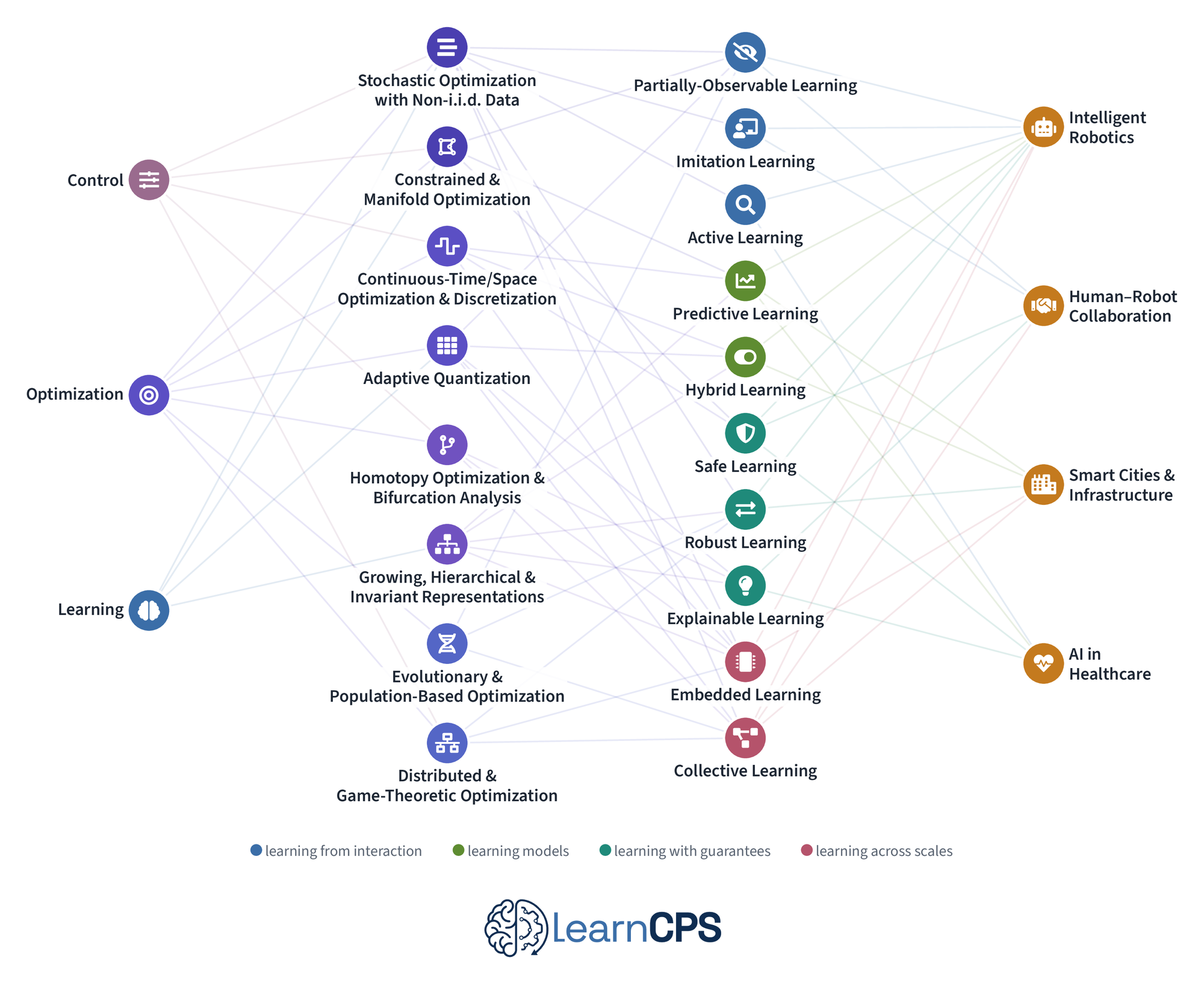
From foundational problems to real-life applications in cyber-physical-human systems.
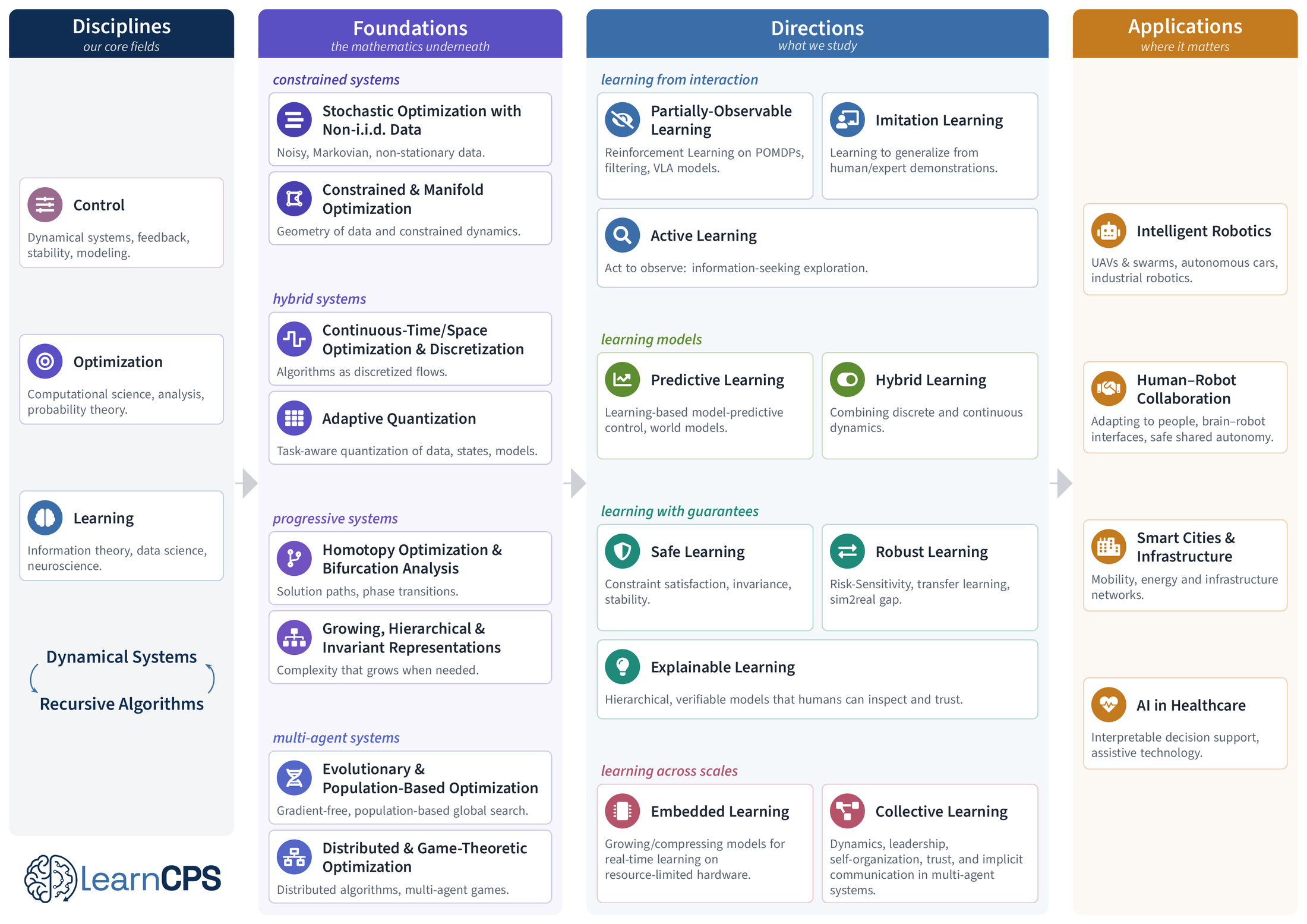
Disciplines
Control
Dynamical systems, feedback, stability, modeling.
Optimization
Computational science, analysis, probability theory.
Learning
Information theory, data science, neuroscience.
Foundations
Our research directions rest on eight foundational problems in optimization and learning theory, grouped by the class of systems they address and each approached from the dynamical-systems viewpoint.
Constrained systems
Stochastic Optimization with Non-i.i.d. Data
Stochastic recursions driven by noisy, Markovian and non-stationary data, the regime of any learner in closed loop, analyzed through their limiting ODEs.
Constrained & Manifold Optimization
Optimization under constraints and on manifolds; learning the low-dimensional geometry of data and dynamics.
Hybrid systems
Continuous-Time/Space Optimization & Discretization
Algorithms derived as discretizations of continuous-time flows, with guarantees preserved under discretization.
Adaptive Quantization
Task-aware quantization of data, states, actions, time, communication and models, with adaptive codebooks that allocate resolution where it matters for the downstream decision.
Progressive systems
Homotopy Optimization & Bifurcation Analysis
Tracking solution paths as a homotopy (annealing) parameter varies; bifurcations indicate when and how model structure must change.
Growing, Hierarchical & Invariant Representations
Representations that grow in complexity only where the data demand it, organize into multi-resolution hierarchies, and respect system invariances.
Multi-agent systems
Evolutionary & Population-Based Optimization
Gradient-free, population-based global search for policy and controller design, combined with gradient-based refinement.
Distributed & Game-Theoretic Optimization
Optimization and learning over networks of agents with local information, including consensus, distributed algorithms, and games among interacting decision makers.
Research Directions
We organize our research by the question it addresses: how systems learn from interaction, which models they learn, which guarantees learning must provide, and how learning operates across scales, from embedded devices to networks and swarms.
Learning from interaction
Partially-Observable Learning
Reinforcement learning under partial observability, belief representations and memory from observation streams, and vision-language-action (VLA) models.
Imitation Learning
Learning policies from human or algorithmic demonstrations, capturing skills that are hard to encode as rewards.
Active Learning
Selecting informative data through information-seeking exploration and experiment design when interaction is costly.
Learning models
Predictive Learning
Uncertainty-aware world models embedded in learning-based model predictive control, enabling planning over predicted futures and online adaptation.
Hybrid Learning
Learning hybrid systems that couple discrete decisions and switching dynamics with continuous control.
Learning with guarantees
Safe Learning
Learning-based control with guarantees of constraint satisfaction, invariance and stability, during learning and after deployment.
Robust Learning
Performance under change, including transfer learning, distribution shift, the sim2real gap, and risk-sensitive criteria.
Explainable Learning
Models whose structure, such as prototypes and hierarchies, can be inspected and verified by humans.
Learning across scales
Embedded Learning
Lightweight, online and progressively growing models that run on embedded hardware under memory, energy and latency budgets.
Collective Learning
Learning in networks and swarms, inferring interaction laws and the emergence of leadership, trust, implicit communication and self-organization.
Applications
Our methods target cyber-physical-human systems in four domains.
Intelligent Robotics
UAVs and swarms, autonomous cars, manipulators and industrial robots.
Human–Robot Collaboration
Learning from and adapting to human partners, brain–robot interfaces, safe physical interaction and shared autonomy.
Smart Cities & Infrastructure
Mobility, energy and infrastructure networks; large-scale multi-agent coordination.
AI in Healthcare
Data-efficient, interpretable decision support and assistive technology.